





Walk any trade show and you will see EPP insulated boxes, seafood crates and food-pan carriers described as food safe. Most of them are. But the phrase hides a long chain: a polypropylene bead grade with only approved additives, a masterbatch colour built from permitted pigments, a moulding cell that does not contaminate the part, and a file of migration test reports that matches the way the container will actually be used. Cut any link and the claim stops being true — even though nothing about the foam itself changed.
This guide explains how food-contact regulation actually works for moulded EPP, market by market, and what a sensible buyer asks for. If you want the material background first, start with what expanded polypropylene is and EPP material composition and safety, or read the plain-language answer to whether EPP material is harmful to the human body.
Food-contact compliance is about the part, not the polymer
Food-contact law across all four markets works from the same principle: a material may not transfer substances into food in quantities that endanger health or unacceptably change the food’s composition, taste or texture. What differs is how each jurisdiction proves it. Whatever the route, the assessment lands on the finished article under its real conditions of use — not on a datasheet for the resin.
The four frameworks that decide market access
These are the regimes that govern moulded EPP sold into the four target markets. They overlap in spirit and diverge in detail — which is exactly why a single-market certificate rarely travels.
| Market | Governing framework | What the buyer should receive |
|---|---|---|
| European Union | Framework Regulation (EC) 1935/2004, Plastics Regulation (EU) 10/2011, GMP Regulation (EC) 2023/2006 | A Declaration of Compliance (DoC) for the article, naming the migration test conditions and results |
| United States | Federal Food, Drug and Cosmetic Act; FDA 21 CFR 177.1520 (olefin polymers) and related additive regulations; Food Contact Notifications where a substance is not already cleared | Resin supplier statement of 21 CFR compliance plus, for the article, documentation that each substance is cleared for its intended use |
| Japan | Food Sanitation Act; Positive List for synthetic resins (CAA), fully enforced since 1 June 2025 | Evidence that base polymer and additives are on the Positive List, plus conformity testing and a Declaration of Conformity |
| Korea | Food Sanitation Act; MFDS Standards and Specifications for Utensils, Containers and Packaging | Material specification compliance plus migration test reports from a recognised laboratory |
European Union: Regulation (EU) 10/2011 in practice
In the EU, EPP is a plastic, so the Plastics Regulation applies. It works on a positive list: only authorised monomers, additives and polymer production aids may be used, each with its own restrictions. Compliance is then demonstrated by migration testing, and carried along the supply chain by a Declaration of Compliance.
- Overall migration limit (OML). The total mass of all substances released must stay within 10 mg per dm² of food-contact surface — or 60 mg per kg of food where the surface-to-volume ratio cannot be established.
- Specific migration limits (SMLs). Individual substances on the positive list have their own limits; substances without a specific limit must still not migrate above 60 mg/kg.
- Positive list. Anything not listed — a pigment, a processing aid, an antioxidant — is not permitted, regardless of how little of it migrates.
- Declaration of Compliance. The supplier issues a DoC identifying the article, the materials, the intended contact conditions and the test basis. Supporting migration data must be available on request.
- Good manufacturing practice. Regulation (EC) 2023/2006 sets the GMP expectations for the whole chain, from resin to finished part.
United States: FDA and 21 CFR 177.1520
In the United States there is no positive list in the European sense. Instead, each substance used in a food-contact article must be authorised by a regulation, be the subject of an effective Food Contact Notification, or be otherwise exempt. For the base polymer, the key provision is 21 CFR 177.1520, Olefin polymers, which covers polypropylene and sets the specifications the resin must meet.
- Polypropylene listed under 21 CFR 177.1520 is specified by density, melting point and extractives limits — broadly a density of about 0.880–0.913 g/cm³ and a melting point in the 160–180 °C range, with maximum extractable fractions in n-hexane and soluble fractions in xylene.
- Those specifications apply to the base resin. Mineral fillers and pigments shift density and melting point, which is why testing is normally done on resin without fillers or colour so the resin itself can be qualified.
- Additives have their own regulations — for example antioxidants and stabilisers under 21 CFR 178.2010, and colourants for polymers under 21 CFR 178.3297. A colour that is acceptable in Europe may not be cleared in the US, and the reverse also happens.
- Where a substance is not already cleared, an FCN is the modern route: the notifier demonstrates safety for a specific use, and the notification becomes effective for that notifier and its customers.
- The finished-article manufacturer remains responsible for using each substance within its cleared conditions of use — the resin supplier’s letter is necessary but not sufficient.
Japan: the positive list for synthetic resins
Japan tightened its food-contact regime substantially. Since June 2020 the Food Sanitation Act has operated a positive list for synthetic resins used in utensils, containers and packaging, and the five-year transition period ended on 31 May 2025 — full enforcement applies from 1 June 2025. For a supplier shipping into Japan, that deadline has already passed, and it changed what paperwork is expected.
- Base polymers must appear on the Positive List — the base-material table currently runs to around 200 approved polymers, with a separate table of many hundreds of approved additives and their use restrictions.
- Every synthetic-resin layer of a container or package is covered, which matters for multi-material assemblies such as a foam body with a rigid insert or lid.
- Compliance combines list-based material review with conformity testing of the finished article against Japan’s specifications.
- A Declaration of Conformity is expected to flow down the supply chain, confirming the material meets the Food Sanitation Act and the Positive List.
- Substances outside the list follow a separate notification or review route — not a route a buyer should be discovering after the container has shipped.
Korea: MFDS standards for utensils, containers and packaging
Korea regulates food-contact materials under the Food Sanitation Act, through the MFDS Standards and Specifications for Utensils, Containers and Packaging. The structure will look familiar to anyone who has worked in the EU: material-by-material requirements, an overall migration limit, and specific limits for individual substances — plus approved material and additive lists that function as a positive list for the categories they cover.
- Migration testing uses food simulants — water, 4% acetic acid and n-heptane are the classic three for aqueous, acidic and fatty foods, with ethanol solutions used for alcoholic and some fatty-food cases.
- Overall migration sits in the same order of magnitude as the EU limit, with specific limits for individual monomers, additives and heavy metals.
- Test conditions follow the real use — from ambient storage through hot-fill to high-temperature preparation — so the container’s declared use temperature matters to the test plan, not just to marketing.
- Repeat-use articles are commonly assessed across successive migrations, with the later result used for the judgement, and durability requirements for reusable products have been tightening.
- Importers frequently need Korean-language documentation and testing through a recognised laboratory, so build the compliance step into the timeline rather than bolting it on at the port.
How EPP itself behaves in food contact
Setting regulation aside for a moment, moulded EPP has properties that make it a genuinely good food-contact material — which is why it displaced a great deal of single-use foam in reusable food logistics:
- Closed-cell structure. The foam does not wick or soak. Liquid cannot penetrate the cell walls, so the container can be washed and dried rather than discarded.
- Low water absorption. Weight and thermal performance stay stable across repeated wash cycles, unlike open-cell or fibrous insulation.
- Wide service temperature range. Moulded EPP keeps its shape from deep freeze conditions through hot-fill and hot-hold temperatures, which supports one container across chilled, ambient and hot food streams.
- Chemical resistance. Polypropylene stands up to many oils, fats, dilute acids and detergents, so food residues and cleaning chemicals do not degrade the surface quickly.
- Impact recovery. The container survives being dropped, stacked and handled roughly — the practical reason reusable EPP boxes last far longer than the single-use packaging they replace.
What a migration test actually measures
Migration testing answers a simple question: what leaves the container and enters the food, and how much? A laboratory fills or immerses the article in a food simulant that mimics the food type, holds it at a defined temperature for a defined time, then analyses the simulant for total and individual substances. The choice of simulant and condition is derived from how the container will be used — not chosen by the supplier for convenience.
| Food it will contact | Typical EU simulant | What it stands in for |
|---|---|---|
| Aqueous, non-acidic | Water or 10% ethanol | Milk, water-based drinks, soups |
| Acidic | 3% acetic acid | Fruit, vinegar-based and acidic sauces |
| Alcoholic | 20%, 50% or 80% ethanol, by strength | Beer, wine, spirits |
| Fatty | Vegetable oil, or isooctane / 95% ethanol substitutes | Oils, dressings, fat-rich ready meals |
| Dry | Tenax | Grains, powders and other dry foods |
Two details catch buyers out. First, foam has a large surface area for its mass, and overall migration is expressed per unit of contact area — so geometry matters, and a test on sheet stock is not a substitute for testing the moulded part. Second, repeat-use articles are assessed differently from single-use ones, because the surface changes over a service life of washing and handling.
Reusable containers carry a durability requirement
EPP earns its place in food logistics in reusable loops — insulated boxes, seafood crates, food-pan carriers, takeaway systems. Regulators have followed: a reusable article is expected to remain compliant after repeated washing, not merely when it leaves the mould. In practice that means testing across successive migrations, and in some markets explicit durability criteria for reusable products.
For a purchasing team, the practical consequences are straightforward. Specify the number of wash cycles the container must survive, and say so in the specification. Ask for migration data on a part that has been through that cycle count, not only on a virgin sample. And pay attention to edge wear and cut surfaces: a foam container cut after moulding exposes cells that a moulded skin would have sealed. Applications such as reusable EPP food delivery boxes, seafood delivery boxes and large insulated food boxes all live or die on that cycle count.
Recycled content: where the rules tighten sharply
Recyclability and food-contact legal compliance are two different things, and this is the single most common misunderstanding. EPP is a genuinely recyclable material and closed-loop return of EPP containers is one of its commercial strengths. But in the EU, recycled plastic used in food contact must come from an authorised recycling process under Regulation (EU) 2022/1616, which replaced the earlier regime in October 2022. The listed suitable technologies are narrow — post-consumer mechanical recycling of PET, and recycling from closed, controlled product loops.
That has a direct consequence for EPP food packaging. A container marketed as recycled because it contains recovered polypropylene is not automatically food-contact compliant in Europe; the recovery route itself needs to sit inside an authorised process. The encouraging part is the second listed category: a closed and controlled product loop is exactly what a pooled reusable container system is. Where a fleet of EPP boxes circulates within a controlled pool and returns to a known decontamination route, the loop can be designed to meet the requirement rather than assumed to breach it. See insulated foam applications and cushion packaging for where those loops are already running.
A supplier checklist for food-contact EPP
If you are sourcing EPP containers or food-contact components, these are the questions that separate a defensible claim from a hopeful one:
- Which exact bead grade is used, and is that grade documented for food contact by its producer — with the statement naming the market and the regulation?
- What colour is specified, and is the masterbatch itself cleared for food contact? If the answer is “any colour”, the answer is probably wrong.
- Are there any fillers, flame retardants or additives other than those covered by the food-contact documentation?
- Has migration testing been done on the finished moulded part, at the specified density and wall thickness, using simulants matched to the actual food types?
- Do the test conditions match the container’s declared use — including hot-fill, heating or freezing where relevant?
- For reusable containers, has testing been repeated after the specified wash cycles?
- Does the Declaration of Compliance name the article, the materials, the intended conditions of use and the test basis — and is the underlying data available on request?
- If recycled content is claimed, through which authorised route does it comply in each destination market?
- Does the moulding process segregate food-contact material — dedicated equipment, controlled regrind, documented mould-release agents?
- Which market’s paperwork do you actually need? Buyers shipping to the EU, US, Japan and Korea at once should expect four separate evidence sets, not one certificate.
Common questions about food-grade EPP foam
Is EPP foam food safe?
Is EPP foam BPA free?
Can EPP containers go in a dishwasher or be steam cleaned?
Can EPP foam be used for hot food and for freezing?
Does a European Declaration of Compliance cover US or Japanese requirements?
Is EPP a better food-contact choice than EPS or cardboard?
Getting the paperwork right before the container ships
Food-contact compliance is not a marketing adjective; it is a chain of documented decisions running from the bead grade to the finished part. Buyers who treat it as a checklist item at the end of a project end up retrofitting colour changes, re-running migration tests and, occasionally, re-moulding tools. Buyers who raise it in the first technical conversation get a container that can be sold into the EU, the US, Japan and Korea with the evidence to match.
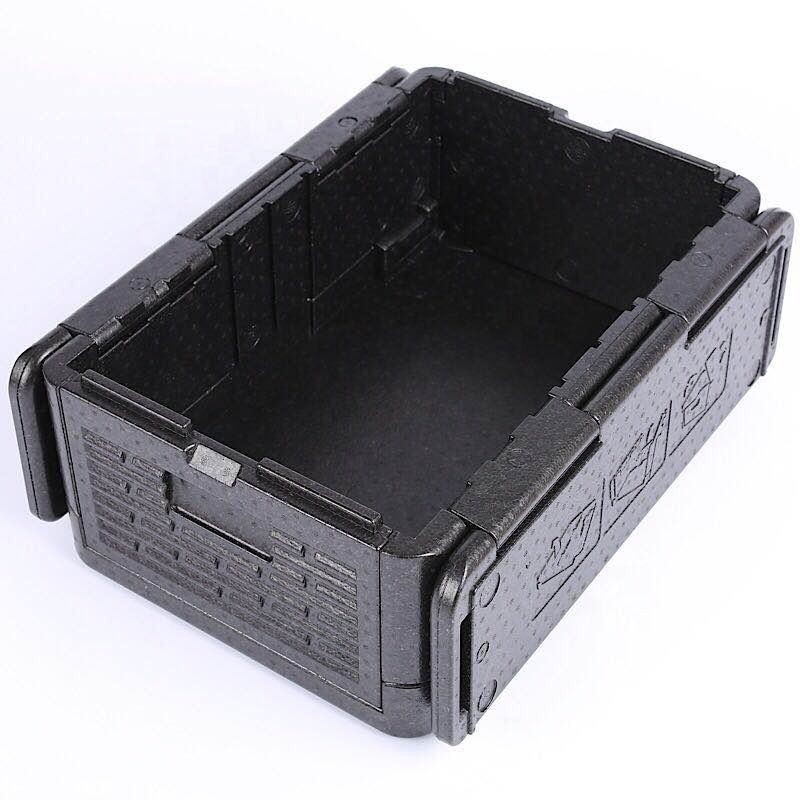
At Qingdao Simingrui Precise Technology we mould EPP and ETPU components for insulation foam, cushion packaging and consumer products, including insulated food containers and reusable food logistics boxes such as the EPP insulated food container, a lightweight insulated EPP cooler box and stacking thermoboxes. Tell us the market, the food types and the use temperature, and we will align the grade, colour and test plan from the start — the wider engineering route sits under customized centre.










 East side of Jiaoping Road, Madian Industrial Park, Jiaozhou City, Qingdao City, Shandong Province
 +86-
+86- market@qd-smr.com
 East side of Jiaoping Road, Madian Industrial Park, Jiaozhou City, Qingdao City, Shandong Province
 +86-15588637956
 market@qd-smr.com