





Ask any EPP supplier for a quotation and one of the first questions back will be "what density?" It is the number that decides how the foam feels, how much load it carries, how much it weighs and what it costs. It is also the number that most buyers guess at, usually by copying whatever was on a previous drawing.
This guide walks through the practical decisions behind a density call. If you want the material background first, start with what expanded polypropylene is; if you already know the material and just need to specify a grade, read on.
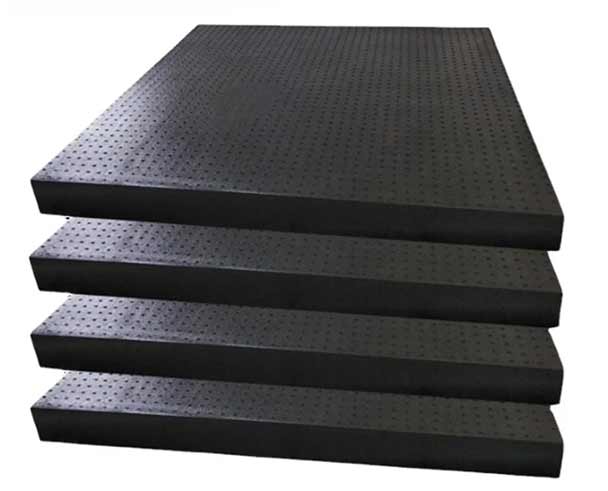
What "density" actually measures in EPP
EPP is made from expanded polypropylene beads that are steam-chest moulded into a net shape. Density is simply the mass of the finished part divided by its volume — in practice, how tightly the beads are packed. A low-density grade uses more air and less polymer per litre; a high-density grade uses more polymer and less air. That is the whole story, and almost every property difference between grades flows from it.
Two clarifications save a lot of confusion in quotation rounds. First, density is a property of the moulded part, not just the raw bead — a moulder can hit a target density by controlling the fill ratio, so the same bead can produce different final densities. Second, density is not the same as hardness: two foams at the same density can feel different if the bead size, fusion quality or resin grade differs. Density is the headline number, not the full specification.
The density ladder: what each band is actually used for
| Density band | Character | Typical role | Indicative compressive stress at 25% strain |
|---|---|---|---|
| 20–25 kg/m³ | Very light, soft, easily compressed | Light-duty packaging cushions, gap fillers, insulation pads | ≈ 100–180 kPa |
| 30–40 kg/m³ | Light but self-supporting | Returnable trays, protective packaging, impact pads | ≈ 180–320 kPa |
| 45–60 kg/m³ | Firm, good energy absorption, holds shape | Structural inserts, automotive energy absorbers, tool inlays | ≈ 320–550 kPa |
| 60–80 kg/m³ | Stiff and dense, near-rigid feel | High-load structural parts, precision spacers, repeated-impact components | ≈ 550–900 kPa |
Which properties move with density — and which do not
A five-step method to pick a density
- Define the load case in numbers. Static load, drop height, number of expected impacts and the peak force the payload can survive — written down, not described verbally.
- Separate the functions. If one part must both insulate and absorb impact, size the insulation by thickness and choose density for the mechanical duty; do not compromise both.
- Start from a mid-band reference. Around 45–60 kg/m³ is the usual starting point for structural and energy-absorbing work; 25–40 kg/m³ for packaging and light duty.
- Test two densities, not one. Mould or CNC-cut a sample of your chosen grade plus one step lighter, and compare. Two data points turn a guess into a decision.
- Lock the tolerance and the test method. "40 kg/m³ ± 5%" measured to a stated standard is inspectable; "40 kg/m³" alone is not.
How density is chosen in practice, by application
| Application | Typical density | Why |
|---|---|---|
| Insulation panels and pipe inserts | 20–35 kg/m³ | Insulation driven by thickness; low density saves weight and cost |
| Reusable packaging and returnable trays | 30–45 kg/m³ | Needs to resist repeated handling without deforming |
| Consumer products (toys, seating, sports cores) | 35–55 kg/m³ | Balance of stiffness, weight and surface finish |
| Automotive energy absorbers and spacers | 45–70 kg/m³ | High, repeatable energy absorption under crash and vibration loads |
| Precision structural inserts and tool inlays | 60–80 kg/m³ | Dimensional stiffness and load carrying dominate |
Two of these bands deserve a note. On insulation, the insulation foam range leans on lower densities because the governing variable is thickness, not mass. On the structural end, grades near the top of the range reach stiffness levels where EPP can displace parts previously made in denser plastics — the same reasoning that put EPP into modern vehicle structures.
Density and everything else on the drawing
Density is one line on a drawing that has several others, and they interact. Wall thickness sets how well the cavity fills, so very thin sections may rule out the lightest or heaviest grades. Moulding shrinkage — typically around 2% — is handled in the tool, not the density call, but it changes the finished part size and therefore the compression you actually get. Flame-retardancy requirements may force a specific grade rather than a specific density; the difference between HF1 flame-retardant and standard EPP is a good starting point there.
It also helps to know how the part will be made. Sheets can be supplied at several densities and thicknesses for cutting and prototyping — see EPP foam sheets and the multi-density EPP sheet range — while production parts are steam-chest moulded to a net shape, as described in EPP foam production, step by step. Starting from EPP raw material specifications is the other way in.

Comparing density with the obvious alternatives
Buyers often compare EPP against EPS on the assumption that density is a like-for-like number. It is not. EPS typically runs 15–40 kg/m³ and is a single-impact material, while EPP at 40 kg/m³ survives repeated impacts without crumbling. A like-for-like comparison has to be made on behaviour, not on the density figure — the EPP vs EPS comparison sets out the mechanical and lifecycle differences in detail.
Common questions about EPP foam density
What is the density range of EPP foam?
Does higher density mean better insulation?
How do I know which EPP density to choose?
Is a heavier EPP part stronger?
Can one EPP part use two different densities?
Does density affect EPP recyclability?
Getting a density decision you can defend
The most reliable route is to treat density as an engineering variable rather than a purchasing convenience. Define the load case, test two candidate grades on a real sample, lock the tolerance and the test method, and keep the data with the drawing so the next project starts from evidence.
At Qingdao Simingrui Precise Technology we mould EPP and ETPU components across the full 20–80 kg/m³ range, and we are used to being asked for the density and the evidence behind it. Prototypes can be produced without tooling, as described in EPP CNC prototyping, and the wider custom-moulding route is set out under customized centre.










 East side of Jiaoping Road, Madian Industrial Park, Jiaozhou City, Qingdao City, Shandong Province
 +86-
+86- market@qd-smr.com
 East side of Jiaoping Road, Madian Industrial Park, Jiaozhou City, Qingdao City, Shandong Province
 +86-15588637956
 market@qd-smr.com